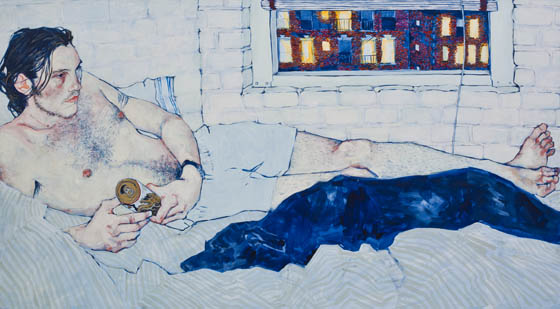
One week after the opening of her third solo exhibition, artist Hope Gangloff frets about her next looming production deadline: costumes for a Halloween party near New Paltz, New York.
“So my friend from upstate calls and he says he’s making his dog [into] Cerberus, the three headed dog that guards the River Styx. And one of my friends is staying with me this week and she said you should keep with the spooky-dog theme. And why don’t you just put a head on your dog’s ass?”
Gangloff holds up the stuffed dog’s head she sewed earlier in the day. She straps it like a belt around the hindquarters of Daisy, her black lab. The stuffed head has a red collar identical to the one on Daisy’s neck, and the plush snout is getting pummeled by her wagging tail.
Gangloff has long, caramel brown hair that she parts on the extreme left of her head and sweeps over the opposite shoulder, secured with a large barrette and a crisscrossed arrangement of bobby pins. Sometimes she brings the hair to her mouth to cover a laugh. Her U-shaped face animates easily, but it looks tired at rest. In the weeks leading up the opening, Gangloff painted late into the night, often sleeping in her studio in Green Point.
“If I have time to get my fucking nails done, then something’s wrong,” Gangloff says. “I could have done more. I could have paid more attention to something. I don’t think there’s any other way around it.”
Probably not, considering the kind of work she produces. Gangloff is a portrait artist whose red, blue, and black ink drawings depict the idle hours of young New Yorkers. Despite their narrow color palette and frequently languorous subjects, Gangloff’s portraits are a frenzy of detail. She draws every whisker on a stubbly chin, every fleck in an iris, and gives equal attention and compositional weight to the patterns of ski sweaters and wallpaper as she does to the creases in a subject’s face. The effect is sometimes a flattening of figure and space, a reminder that the images are drawn from photographs.
“I have my camera on me at all times and I’m a total nuisance with it,” Gangloff says. As such, she captures her subjects off guard―yawning, napping, watching television. They’re sometimes boisterous and cross-eyed drunk. Gangloff credits her friends, most of them artists of one sort or another, with knowing how to throw a good party.
It’s only fitting that her work has appeared in liquor ads. Some of her drawings are veritable hymns to the post-party empties pile. And though her subjects occasionally clasp a cigarette while polishing their toenails or staring down the neck of a bottle, Gangloff says she won’t endorse tobacco companies or certain other industries. “Pharmaceutical companies,” for example, “can suck it.”
But illustration isn’t Gangloff’s main objective. While she has taken assignments to draw Anna Wintour for the New York Times and Harry Potter for the New Yorker, many of her illustration credits, such as her many appearances on the website My Open Bar, are just fine art pieces re-purposed. Gangloff likes assignments when they steer her toward new ideas. “Sometimes I have more fun interpreting other people’s ideas,” Gangloff says. “But sometimes I like doing my own thing and that’s when it sucks to be an illustrator.”
Gangloff is 35. She grew up in a Sears kit house in Amityville near the south shore of Long Island, where her parents still live. Her father worked as a draftsman and was an amateur musician who played tuba and upright base. Her mother was a school teacher and she and Gangloff used to take painting classes together sitting side-by-side at their easels when Gangloff was a child. In 1992, Gangloff enrolled at The Cooper Union’s School of Art, about five blocks from the East Village apartment she now shares with her husband Ben Degen, an artist who also trained at Cooper.
“Cooper Union pushes you really hard,” Gangloff says. “Like, you have a show coming up next week for four years. Well, if you’re doing it right. You should be pushing yourself that hard because it’s the only time in your life you’ll get free studios and a pretty good price on room and board. Anybody who goes to Cooper should be taking full advantage of it.”
During her senior year, she fell off a loft bed onto a log she’d been planning to carve and broke her left arm in two places. Gangloff is left-handed so she completed her final senior exhibition, a series of paintings on ten-by-fifteen boat tarps, with her weaker hand. She was too groggy with painkillers to consider fulfilling her humanities requirement, so she never graduated.
After leaving art school, Gangloff spent a year in Montana where her brother was doing field research in biology. She got a job as a metal chaser in a foundry that specialized in somewhat gaudy, ornamental bronze casts of wildlife, a white-tailed deer for your lawn, say, or a coffee table made to look like an elephant. Gangloff’s job was to sculpt the welding seams into scales or fur or feathers. She performed this task with a rotating diamond bit that vibrated so violently, her whole body would shake as she struggled to hold her working hand steady.
That same year, Gangloff illustrated a graphic novel that a friend of hers had written. She was making a little over six dollars an hour at the foundry, so ordinary roller-ball pens became her medium of choice. The book was never published, but Gangloff kept drawing with ink. She eventually upgraded to nib pens and shellac ink on clay-coated paper, which lends a more lustrous finish and better colorfastness. The improved fidelity and durability of these materials matter to Gangloff’s work; some of the pieces from her early career have lost all of their red tones to sun exposure.
Gangloff’s current exhibition, on view at Susan Inglett Gallery in Chelsea until November 25, includes a few of the ink drawings that the artist is known for, but the focus of the show is seven large acrylic canvases. A few of these are nudes, including “The Trouble with Paradise,” a portrait of Gangloff’s friend Lina Hellden seated on a lakeside dock and scowling at her cell phone. As if by force of habit, some of the paintings are confined to the same blues and reds of Gangloff’s inks. But paint is a subtler medium and puts flesh on the bone in a way that is impossible in line drawing. All of Gangloff’s work has energy, but the paintings have more life.
The only male portrait is “Ashley Streeter Darrell,” solemn in boxers, reclining on a tousled comforter and cradling a beer can in his hands. “That one kind of put my schedule on its ear because I couldn’t do justice to his beauty,” Gangloff says. The model was an artist who had appeared in Gangloff’s work in the past. This portrait was posthumous; Darrell committed suicide last spring.
“My husband and I were upset that when you looked up this person on the internet the only thing that came up was that he had killed himself. And Ben and me, we want there to be something beautiful that comes up when you look up his name. So my husband is working on a painting of him too. And we’re just going to name the paintings after him.” The tribute was successful; that is, news of the show outranks Darrell’s obituaries on Google and Bing.
Gangloff says she isn’t sure how much more of her career she’ll devote to portraiture. “I really plan on having no plans,” she says. “I’ll probably always do something to tease my friends in some capacity. Or to do something loving for them.”
October 2009


Realizing now I never actually saw her work. I love the image in this post, though.